
Wondering what these hushed, woodsy songs are really about? Indie folk lyrics themes circle a few ideas: nature, loss, memory, home and the search for connection, told in plain, intimate images.
This guide is part of our wider look at indie folk music.
| Item | Value |
|---|---|
| What makes the genre feel “natural” | Nature-themed content and naturalised geographic and environmental experiences |
| Philosophical tradition behind the lyrics | Transcendentalist-inflected environmentalism |
| Origin story often told about the music | The “cabin in the woods” narrative |
| Era of writing revived, per one thesis | Romantic Era and Transcendentalist ideals |
| What Romantic writers emphasised | Nature, emotion and the imagination |
Figures and claims come from UCLA’s Ethnomusicology Review and a University of Central Florida thesis. Scholarly readings can change or be disputed, so check the sources before you rely on them.
Nature as the genre’s home ground
Woods, rivers, snow, seasons and weather turn up in indie folk constantly. One academic reading argues that calling the genre “natural” refers to its nature-themed content and its naturalising of certain geographic and environmental experiences.
That is a useful lens. A line about a frozen lake is rarely only about a lake; it usually stands in for a mood, a relationship or a stage of life.
The same UCLA article says Bon Iver’s Justin Vernon stays committed to indie folk’s transcendentalist-inflected environmentalism, even as his sound adds urban modernity. Nature, in other words, is both a setting and a value system.
- Seasons mark time passing and relationships ending.
- Wilderness stands for solitude, honesty or escape.
- Weather mirrors the narrator’s feelings.

Solitude, retreat and the cabin story
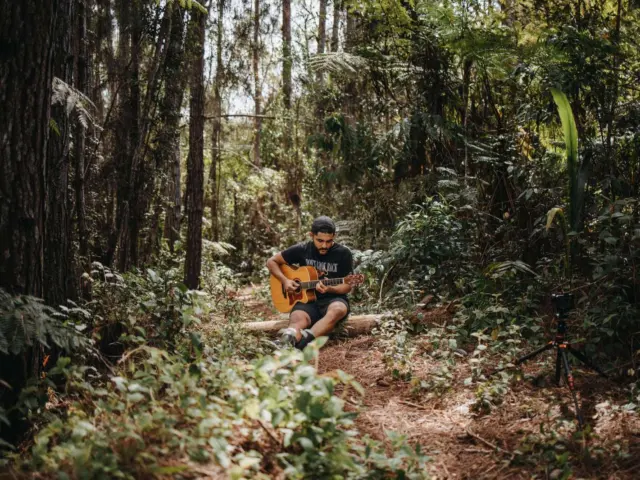
Indie folk has a favourite myth: the artist who retreats to a remote place and comes back with songs. The UCLA article notes that this narrative is signalled by phrases like “cabin in the woods” or “middle of nowhere”.
The idea seeps into lyrics too. Many songs are written from a distance, with a narrator who is alone, watching, or recovering, and who speaks quietly rather than shouting.
The article also argues that Vernon builds a “woods” in sound rather than simply mirroring the physical woodlands that inspired the song. The wilderness becomes an emotional space as much as a real one.
Loss, grief and fading relationships
Because the delivery is soft and the images are small, loss tends to arrive through details: an empty room, a coat left behind, a season that has changed.
Songs often stay inside the aftermath rather than telling the full story of the breakup. This links to the old folk habit of starting a tale near its end, a trait associated with the traditional ballad.
Listen for these common moves:
- A concrete object or place that holds a memory.
- A direct address to a former lover, friend or family member.
- A refusal to resolve the feeling neatly.
Nostalgia, childhood and home
Looking back is another signature. Indie folk often romanticises small towns, family houses, childhood summers and the people who left or stayed.
The University of Central Florida thesis frames this as part of a wider revival. Its author says close readings show modern music reviving Romantic Era and Transcendentalist ideals.
The thesis says Romantic writers stressed nature, emotion and the imagination, in opposition to logic, reason and the technology of the industrial revolution. That helps explain why the genre feels like a quiet refuge.
Spirituality, doubt and searching for connection
Hymn-like imagery, questions about meaning and a longing to belong run through many records. The language is rarely doctrinal. It is more often a search, with open questions and no tidy answer.
This is where indie folk overlaps with its stranger cousin; if you want the weirder end, see our explainer on freak folk meaning.
Many of these songs are written to be shared in person. If you want to hear them in a crowd, the guide to indie folk festivals is a good place to start.
Love, intimacy and everyday life
Not every song is about heartbreak.
The appeal is recognition. When a writer names a small, ordinary moment, listeners feel seen in a way grand declarations rarely manage.
Friendship, parenthood and family ties get the same treatment. Songs about a sibling, a grandparent or an old friend often sit alongside the romantic ones on the same record.
Identity, growing up and self-doubt
Another strand is the uncertain young adult. Narrators wonder who they are, whether they chose the right path, and what they owe the people they left behind.
This is where vulnerability becomes a lyrical style. Writers admit fault, confusion and fear in plain words, and the soft vocals invite listeners to lean in.
Common questions in these songs include:
- Did I leave something important behind?
- Can I forgive someone, or myself?
- What does it mean to belong somewhere?
Because the answers are rarely given, the songs feel honest rather than preachy.
Craft: plain words, strong images
The vocabulary tends to be simple. Writers lean on short concrete nouns and verbs, then let one unusual image carry the emotional weight.
Repetition does a lot of work too. A single phrase can return several times, changing meaning each time as the song moves around it.
Many songs also use second-person address, speaking to a “you” who may be a lover, a friend or the narrator. The listener is invited into a private conversation, which is a big part of the genre’s intimacy.
How to read an indie folk lyric
You do not need a degree to enjoy the words. A few habits make the imagery easier to follow.
- Ask what the natural image stands for emotionally.
- Notice who is being addressed and who is absent.
- Treat sound and words together; arrangement can add as much feeling as the lyric.
- Expect ambiguity. Many writers leave gaps on purpose.
Try it with a record you already love. Read the lyrics once without the music, then listen again and see which images stay with you; the gap between the two often shows how much the arrangement is doing.
Not every writer fits this mould, and some artists use the same imagery in very different ways. Treat the themes here as tendencies, not rules.
Frequently asked questions
What are the most common indie folk lyrics themes?
Show answer
Nature, loss, nostalgia, solitude and the search for connection come up most. Nature is the thread that ties them together, often as a mirror for emotion.
Why is nature so important in indie folk?
Show answer
One academic reading says the genre is called “natural” because of its nature-themed content. Transcendentalist ideas about the natural world also shape how many writers use it.
Are indie folk lyrics usually sad?
Show answer
Often reflective rather than purely sad. Loss and longing are common, but many songs also carry comfort, gratitude or quiet humour.
Do indie folk songs tell stories like traditional ballads?
Show answer
Some do, but many favour impressions and fragments over a full plot. The storytelling instinct of older folk is still there, just more personal and less linear.